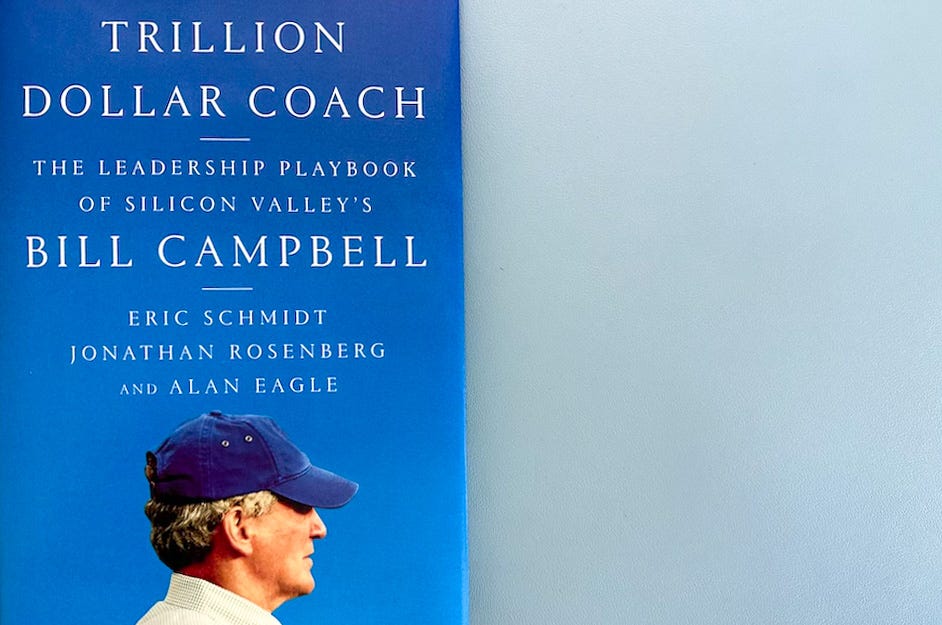
The Trillion Dollar Coach book by Eric Schmidt et al.
What better way to understand how to form high-performing teams than by learning from The Coach? The Coach is Bill Campbell, Silicon Valley’s most famous business coach with mentees such as Steve Jobs, Larry Page, Sergey Brin, and many more. Following his passing in 2016, his lessons were captured in a book (The Trillion Dollar Coach) written by Eric Schmidt et al.
This is my attempt to structure it in a way that I can use its learnings on a daily basis. All quotes are from the book.
Let’s start with answering the “why do I need a high-performing team?” question. In Bill’s view, the hardest part of any product lifecycle is achieving product market fit. That’s the magical milestone where all the pieces come together, and you realize that your product actually solves a problem in the market, one that customers are willing to pay money for. Once you’ve achieved that, you’ll immediately start facing competing market forces, and you have to capitalize on your insight as quickly as possible. In other words — RUN!
How exactly do you “run”? What allows you to move as fast as possible and solve all the problems that come up while capturing most of the value?
High Performing Teams
For Bill, the answer is to form High-Performing Teams and give them the resources and the freedom to accomplish awesome things. To understand that in more detail, we’ll need to talk about the manager’s role, the team culture, and the traits of the people on the team.
Manager’s role
The most important thing the manager needs to do is to ensure people are effective at their jobs while growing and developing. This comes from three pillars: support, respect, and trust.
Support means providing your team with the resources, tools, time, feedback, and coaching they need to succeed. It means helping them grow. Respect means understanding each individual, their career goals and aspirations, and their unique path in life. And Trust is the essential link that allows the freedom and courage to make decisions and accomplish great things.
A secondary yet crucial part of the manager’s role is ensuring the organization has a great decision-making process. This means making sure that all the voices are heard and considered and that the process is fast. Failure to make a decision is as damaging as a bad decision. And the decision should not be made by consensus. If there’s uncertainty, the manager must make the call.
He believed in striving for the best idea, not consensus. “I hate consensus”. the goal of consensus leads to groupthink and inferior decisions. The way to get the best idea was to get all of the opinions and discuss them in the open. Air the problem honestly and ensure people have the opportunity to provide their authentic opinions, especially if they are dissenting.
Team culture
In my view, the whole book can be captured in this word: “trust”. It’s the underlying theme, and I think Bill would agree with that.
For Bill, trust was always first and foremost; it was sort of his superpower. He was great at establishing it, and once established, he was great at honoring it.
Trust is the basis of the team culture and enables “psychological safety”, the number 1 indicator of high-performing teams, as per the now famous Google study. It means that people are comfortable being themselves at work and are encouraged to take risks.
Once you have trust, you need to start setting the bar high and challenge the team to accomplish awesome things. They can now set their goals at 10x, not 10%. Crucially, as a manager and coach, you’ll need to be there along the way and provide the support and feedback they need.
We often feel torn between supporting and challenging others. Social scientists reach the same conclusion for leadership as they do for parenting: it’s a false dichotomy. You want to be supportive and demanding, holding high standards and expectations but giving the encouragement necessary to reach them. Basically, it’s tough love. Disagreeable givers are gruff and tough on the surface, but underneath they have others’ best interests at heart. They give the critical feedback no one wants to hear but everyone needs to hear.”
To accomplish this, you must also engage in active listening (“listen to understand, not answer”) and practice radical candor. Discuss the hard things first, don’t shy away from them. And always be the one to bring the energy level up.
Emil Michael says, “He would always convey boldness to me. It would always give me such a boost. That’s one thing that I learned from Bill: be the person who gives energy, not the one who takes it away”.
Individual traits
Finally, a high-performing team needs to be formed of individuals that encompass the values that will drive success. Per Bill, these are:
Smart — understand things fast, make connections between different areas (“Far analogies”)
Hard-working
High integrity
Grit — you’ll get knocked down repeatedly; you need to have the passion and perseverance to get up and go at it again.
In addition to the ones above, as a coach, he looked for people that also embodied honesty, humility, and have a strong desire to learn.
My lessons
With the book insights structured above, here are some ways how I’m going to apply them.
I’m already on the “never skip your 1:1s” train, but the book made me think about how to structure them better. I like the “support/respect/trust” trio, and I’ll use it to verify if I’m asking the right questions. Does my team have the resources, tools, and time they need? Have I provided enough feedback? Has it been timely? Do they have clear career goals, ones that pertain to them individually? Is there trust in the team?
From an individual interaction perspective, there are three things that I need to work on as it relates to my discussions with the team: have radical candor, push for courage, and bring energy. All three are related, and the trick is to use them in a way that is still natural for me. But just being aware of them is a significant first step.
Decision-making has long been on my top 3 list of issues in my current projects. Seeing it so clearly described by Bill — “I hate consensus” — gives me the motivation to go fight for change. And to be clear, I love that everybody has a voice — but as one of my colleagues said to me recently, not everybody gets a vote.
Finally, the importance of trust for team culture is a subject near and dear to my heart. Seeing Bill placing so much emphasis on it reinforces that belief. Trust can be increased through open communication, transparency, regular team-building, collaboration, and appreciation as needed. You need to actively grow and maintain it, it doesn’t come by default.
Wrap up
Each company is different, and each leader has a different view of what’s important. Bill’s success as a coach shows that some values transcend all of that.
For Bill, the path to success was creating high-performing teams and giving them the tools and freedom to do great things. He believed in managers who put people first, and that leadership is earned. He believed in trust and loyalty, listened completely, and instilled courage and energy in people.
Thank you, Bill. I hope your lessons will live on. And in your words, “we’ll try not to fuck it up.”
Bonus — My Whimsical board of the ideas in the book
P.S. Originally published Nov 13, 2022.